
Leha Salam
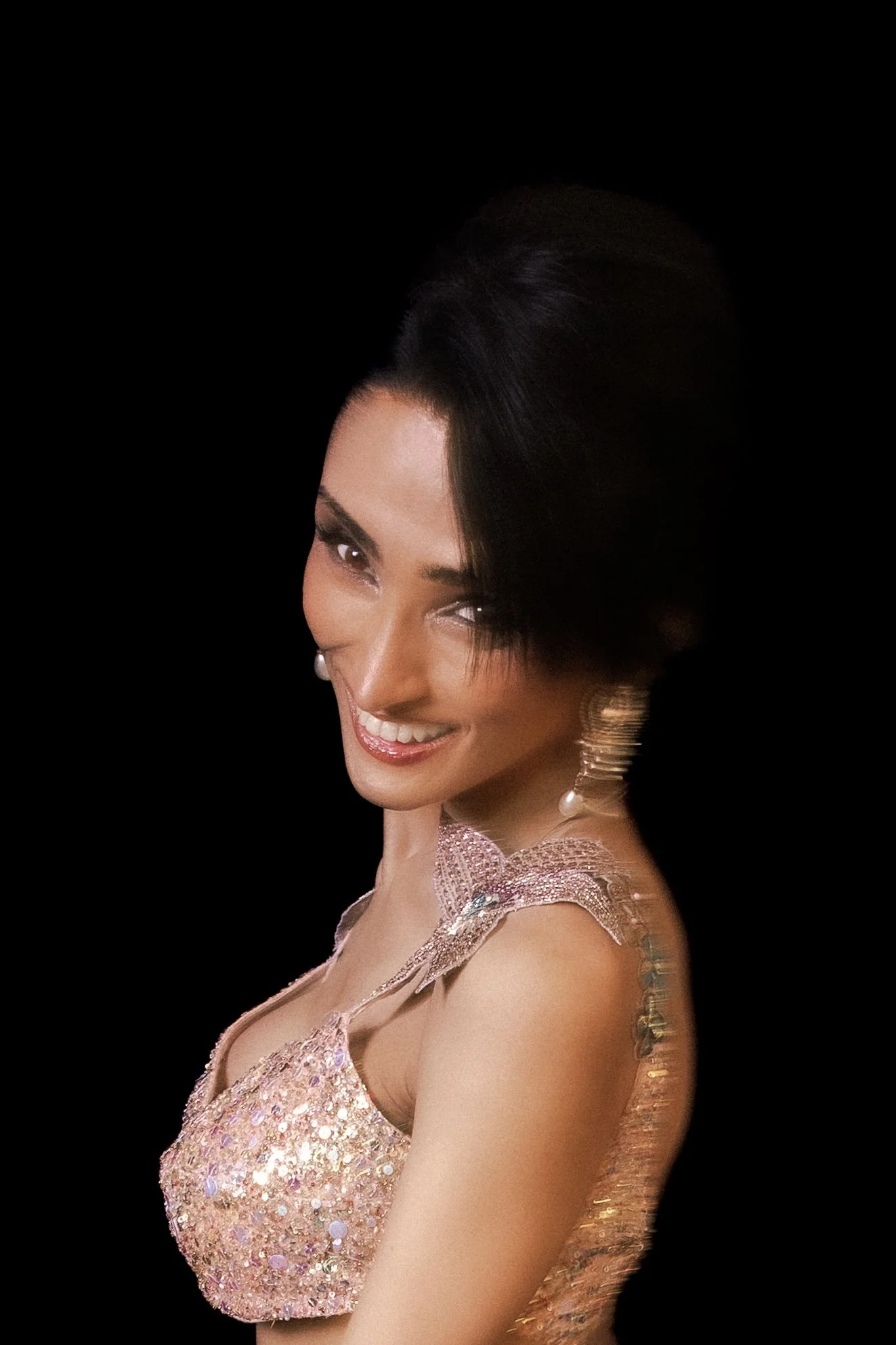
Leha Salam is a Chicago-based writer, performer, educator, and community organizer whose work explores identity, memory, and the reclamation of marginalized narratives. Raised in Abu Dhabi and Dhaka, her interdisciplinary practice explores queer reinterpretations of South Asian literature and pop culture. Salam served as Board President of Trikone Chicago in 2015, where she led pioneering coalition-building with AAPI and BIPOC organizations to expand trans, Muslim, and femme representation and remains an active community organiser working to foster inclusive, joy-centered, and activist geared spaces for queer South Asian & BIPOC communities.
Professionally she has also worked as a community educator and in advancing services and access for transgender healthcare, including roles at the Ann & Robert H. Lurie Children's Hospital of Chicago as an LGBTQ and Gender Inclusion training facilitator.
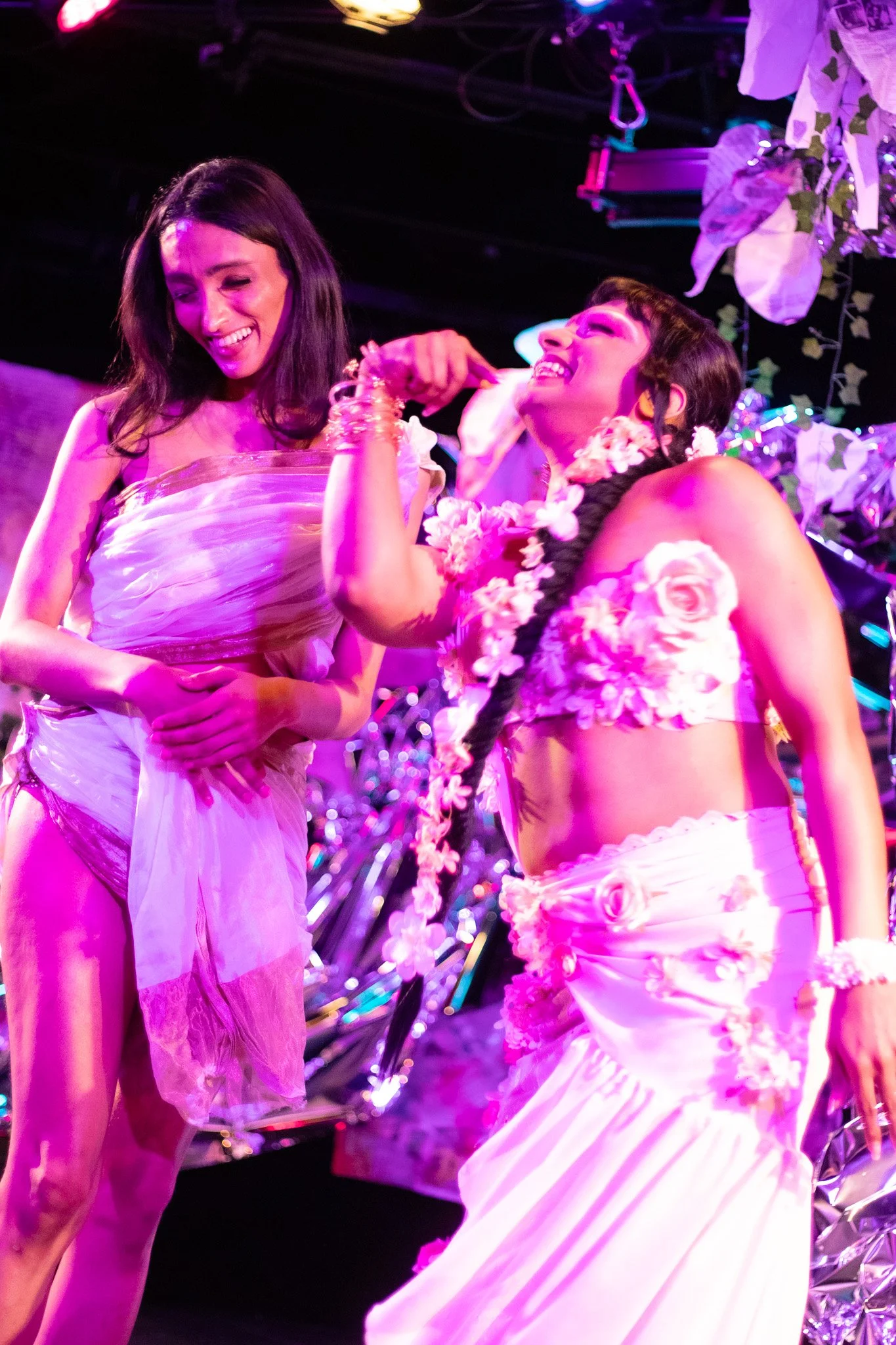
As the co-founder, writer, and performer for the Chicago-based queer and trans femme South Asian theatre collective Dream Devis, Salam co-created their sold out eponymous show in 2025. Ahead of their upcoming second production at the Steppenwolf, Dream Devis: The Death and Life Of, in this installment of SAI’s Community Conversations, intern Shireen Amna Waraich speaks with Leha Salam about her artistic evolution, the ‘magpie’ nature of queer pop culture reclamation, the healing power of radical imagination, the vital role of queer and trans visibility and storytelling as a praxis of empathy.
You’re often classified as a Bangladeshi artist or a South Asian American artist, but you had the specific experience of growing up, for the most part, in Abu Dhabi. What are some of your strongest memories of your childhood in the Gulf and how did it shape your understanding of who you are?
The thing I remember most distinctly about growing up in Abu Dhabi was the safety; you could stay out in the streets till one or two in the morning and not worry about a thing. It felt similar to how people talk about the safety of suburbs vs the paranoia of “big city life” here in Chicago or New York. Of course, it’s not like that and we know cities are often safer because you’re surrounded by people, there’s public transit and more progressive spaces and people are more welcoming. But in Abu Dhabi, we’d hear the same kind of rhetoric of children being safe in the streets late at night and I was indoctrinated with that messaging. It was lovely to have that freedom to be able to roam around and that there were certain things you didn’t have to worry about.
But when I look back, we were getting such a specific version of life there. I grew up in a fairly conservative Bangladeshi Muslim community, and the community was sort of closed off in a way typical of immigrant communities — especially South Asian immigrant communities — that stick together. We all went to picnics together and did cultural programs together, but we didn’t see the world outside or what Abu Dhabi looked outside of that to a great degree. We had such a circumscribed picture of what it meant to be living in Abu Dhabi.
The other thing I remember is the built-in racism that we just accepted as second-class non-citizens. If you’re a British or American national you’re treated much better than if you’re brown or South Asian. There’s also a clear hierarchy in those Gulf Arab countries where Arabs are the “real” Muslims and we’re “fake” Muslim because we don’t speak Arabic. We grew up internalising and accepting that hierarchy. We accepted that it was okay for us not to be citizens, for us to be living in a monarchy and not a democracy, to be singing the national anthem of this country that we could never be citizens of, to not have freedom of expression, or freedom of press.
No one questioned these things and many people I grew up with still live there and don’t question it; they think living in Abu Dhabi or Dubai is the best thing in the world because of the safety, the money, the nice malls, and the cheap gold. It is a cultish fantasy sold to you as a child by your parents and the community. You totally buy into it until you step out.
I stepped out to live in Dhaka in my mid-teens and it felt like a completely different world — grimy, busy, and one of the most population-dense places on earth. But at the same time, suddenly, I was questioning things that I never did in Abu Dhabi. There was all of this political unrest, but at least there was political unrest. It meant that people could get out on the streets and make noise. They might be treated badly by the government, but things could happen, chaos could happen.
In a place like Abu Dhabi, there was no crime because there would be an immediate crackdown and dissidents would “disappear.” Once I got to Dhaka, looking back at my life there felt like an “Stepford-ish” existence. I was very glad to have gotten out after I realized that, even if I didn’t have the constant air conditioning and nice taxis. It was really liberating. People talk about South Asia and focus on religious intolerance or the political unrest, but at the same time it feels like “real life.” Things are happening under the surface and in the gullies and in the corners; life happens in spite of the government and the state. That isn’t the case in the Gulf. Moving from one to the other, it does really feel dystopian and because the Gulf is so shiny and pretty, that dystopia is only more heightened.
How was the transition to life in Bangladesh and Dhaka? Did you feel any cultural disconnect or was it easy to settle into life there?
It was incredibly hard at first. Being middle class in Abu Dhabi was a completely different standard of living than being middle class in Bangladesh. We weren’t very well off but for my parents, the big thing was education, and they put us in these nice schools. In Bangladesh, nice schools meant being around the children of diplomats and politicians and the haves. The income and wealth inequality in South Asia is just staggering. You have five-star hotels and children begging right outside. So, it’s a different kind of dystopia and coming into that was a staggering cultural shock. Coming to America from South Asia was less of a cultural shock for me than it was coming from Abu Dhabi to Bangladesh.
But life was just so much more chaotic and there was so much more freedom of a different kind. You could go out and get on a public bus or on a cycle rickshaw and just go anywhere. It was dangerous, but it was also exciting. You can do whatever you want, break these rules and maybe it meant that bad things could happen to you, but you were also experiencing so much more life. In those 4 years I was there, it just suddenly felt like I was living so much life. That’s what I remember from Bangladesh. It wasn’t necessarily a pleasant experience, but I’m very, very glad I had it.
You were also a teenager coming to terms with your queerness and identity. How were those experiences like in both Abu Dhabi and Dhaka?
In Abu Dhabi, I didn’t know about any queer community though I'm sure it existed in some form. I didn’t know about it and the only way I heard of queerness was in the form of harsh slurs. When I came to Bangladesh, the community existed. Maybe it was underground, but there was community. You heard about activists — some of whom were attacked or even killed by Islamists shortly after I left — but that life existed. I met feminist activists, gender rights activists, queer activists, artists, Marxists and people of all of these tribes, doing all of these things.
There’s a common adage that people in immigrant communities live in a time warp. If your parents moved in the 70s, they are living in the India or the Pakistan or the Bangladesh that they lived in and left behind in the 70s. Meanwhile the country that they left behind has moved ahead and has changed so much but your parents are creating this conservative bubble for you in this other than this foreign country. So when I came back to Dhaka it was a shock to see that “wait, the kids here are nothing like that.” They were smoking, drinking, wearing miniskirts and much more westernised. They were doing whatever they wanted.
I felt like such a child or like a provincial compared to them. I was entering these fancy international schools in Bangladesh, and these kids felt like they were straight out of an American high school TV show. They were dating and doing all these things I had no idea about.
I was such a baby and that culture shock made me grow up very fast. But it was vital because it taught me that our people are not a monolith. Desis, South Asians, and South Asian Muslims are not just the stereotype of people who blindly listen to their parents or are religious in only one “correct” way. They’re complicated, complex, and flawed, and it was important for me to see that.
You’ve mentioned that your understanding of gender emerged through art, rather than politics. Can you speak more about how literature and cinema helped you find representation of queerness and navigate your identity? Did that change when you moved to Bangladesh?
Because my existence was so isolated — as the only queer trans person in my immediate family unit, the only queer trans person in my community, in my class, in my school — the only people that I knew I could pull inspiration from, that I could model my personhood on, were in art.
I had to learn how to be a girl or woman from cinema. I had to learn how to be a woman from books. My favorite book when I was growing up was Anne of Green Gables — I thought “this is the kind of girl I wanted to be” and I projected myself on those characters because I didn’t have anyone around me. Usually girls have their moms, their sisters, or their girlfriends to pull from. I didn’t have access to any of that.
My entire world was my inner life. Even when I think back to my favorite memories growing up, I think of me by myself reading, me by myself watching movies, me by myself dancing, which might sound sad, but they’re happy memories to me. When I came to Bangladesh, I found queer people but so much of that life as a teenager coming into my queerness was closeted or sexualized. The larger identity piece of it, that very personal piece of it, the piece of it that was about personhood was still something that I was drawing from art.
My earliest gender memory was from when I was four or five, whirling and dancing in my living room thinking “I’m a pretty girl.” Another early memory is watching this film with Sridevi and thinking that I wanted to be Sridevi so bad. Those are some of my earliest memories but of course, those things are knocked out of you. People train you to believe that you’re not this thing that you know you are. They tell you you’re a boy or you’re this, that you should want this, that you should want this kind of life. And I believed that for a long time.
But then you read things and you watch things and you realize there’s another possibility for me. There’s another way. There’s a way out for me. There’s another way of living for me. I just have to get there. Art was that respite; it was the possibility of a different kind of existence. That’s what it offered.
I love that you say your earliest memories aren’t lonely — there is a comfort in knowing who you are from the start. It makes sense that you needed that radical imagination, especially in a world that tells you that you cannot exist in it. Apart from Anne of Green Gables, were there other pivotal books? I know you’ve noted Virginia Woolf’s Orlando and Judith Butler’s work as books that opened your worldview
Orlando was a turning point for me. I went to college in the South, and it was a quintessential queer English major experience of reading Orlando and having it blow your mind. I read that book and suddenly everything coalesced for me. All of these memories came back, and I had a moment of thinking “wait, this is who I am.” If this woman born in Victorian England and who’d lived through the first world war, could envision a world in which there was fluidity of gender, it meant that that was a possibility. That kind of radical imagination had existed historically.
In a South Asian context, when we talk about gender we often rely on mythology. While that is great, it wasn't as relatable. For me, reading the book in beautiful, moving, exciting prose, about this character who was not bound by gender, just blew my mind open. Orlando unlocked my subconscious. Suddenly, all the parts of myself that I’d forgotten about, how I’d related to myself as a child, and how I’d related to myself under all those layers of repression, conditioning, and abuse came back. It was incredibly euphoric and healing.
After your undergraduate years in the South, how did you find your way to Chicago?
It’s a bit silly, but I actually followed a partner who had a job opportunity here. At that point, I was a “bad Desi” — I was a humanities major in English with no real plan or job lined up. I was seeing it as it came.
I’d visited Chicago a couple of years prior, and it was freezing cold December. I was at the Art Institute’s modern wing, and I remember looking out of its giant floor to ceiling windows and thinking, “I could live here. I’d be happy if I lived here.” So, when the opportunity came and the person I was seeing then mentioned Chicago, I took it as an omen or portent. I moved and I’ve stayed here since then.
How did you or who helped you find your footing in the city?
When I first got here, life was incredibly hard. It was right after the Great Recession and I was in the wave of millennials who were having trouble finding work. As an immigrant with no health insurance, it felt like there were more odds stacked against me. But eventually, when I overcame those barriers I started finding community in the city.
Once I found Trikone, the queer desi organisation in Chicago, things unlocked for me. I had never had a queer desi community before that; a community purely in that platonic communal sense of queer desi people who like to hang out together. Coming from my liberal arts but mostly white college, Trikone was completely novel for me. Finding queer desi people who were listening to South Asian music and being in a room full of queer people who were dancing through the songs that I’d grown up with, and who knew the cultural references that I knew was exhilarating.
I met some of my best friends in Chicago at that point through Trikone and though my view of the queer desi community got more complicated over time, at that point it was just incredible and something I really needed. It was pure unalloyed good. I would attend Dyke March, Pride, and go shopping with all the friends I met through Trikone. I also identified as gender queer and non-binary, so we were experimenting with gender expression together and going to Bollywood films together. It felt like life had finally begun.
You also served as the President of the Board for Trikone in 2015. During that time, your understanding of the community also became more complex and you prioritised making Trikone a more inclusive space for women, trans, gender non-conforming and femme people. Why was that important for you?
Spaces are just more boring when they are monolithic. If a space is dominated by cis gay male voices, or only one kind of voice, that space is going to be boring. This is a space I was getting so much out of, but I heard from women and trans people that they didn’t feel welcome and were being pushed out. I hated that that was happening and even though a lot of the core leadership were cis gay men and sympathetic to these complaints, they weren’t gauging the full weight behind those concerns.
Identity-wise I was closer and I could sense that there was real legitimacy to those concerns. I was also very eager to work with them. I wanted to hang out with not only queer women, lesbians, and trans people, but with other AAPI people. I want to partner with them and to work with i2i (Invisible 2 Invincible: Asian Pacific Islander Pride of Chicago) and go to the NQAPIA (National Queer Asian Pacific Islander Alliance) conferences.
I wanted to do all those things like partnering with other AAPI and BIPOC groups, simply because those things felt more “fun.” It was a bit selfish in that way, but it was a better way to do things. It’s a more vivid life to be inclusive and inclusive is more fun and you get more out of it. I’m still on the board and one of the reasons I do remain on board is because that representation still remains low. Being the only woman, the only Muslim, and the only trans person on the board, I would like to believe it makes a nominal difference. Of course one gets burnt out on this kind of work, but for me it’s still worth it to push through it.
What are some of your favourite memories or particular moments that stand out from your time at Trikone?
I always remember the little things. Being at the Dyke March with my friends was really special because it is such a radical space. As South Asians, oftentimes there’s a fear, understandably, regarding radical or politicised spaces, especially now with the current crackdowns on immigrant communities. Being able to overcome that conservatism to go out there, wave a banner, and be visible felt incredibly cool and liberating. I also cherish just hanging out with my besties and realizing we were doing this work together — whether it was getting drunk at a potluck or dancing at a Jai Ho (which is the queer South Asian dance party Trikone hosts) Performing at those events are some of the memories that come back to me. It also felt really rewarding when people would tell me they’d returned to Trikone after a while because it finally felt different — more welcoming and better than before.
It’s clear you emphasize both inclusivity and joy. When people discuss queer South Asian communities, the narrative often gets stuck on the struggle or solely on activism. Why has joy been such a vital part of how you think about finding community or a constant throughline in your work?
People often talk about joy as resistance, but I don’t know if it’s as simple as that. Ultimately, for me the work is resistance —the work that we do, the work people do, the work the people outside detention centers who are getting tear gas do, the work people going to DC demanding legislative change do. All that tireless work is resistance.
But what are we doing the work for? The reason we’re doing the work is to create a world where people can experience joy, where people can make art, and people can love each other — where it can be more about just survival. We’re trying to create a world through all this resistance and painful pushback that has ease in it, that has rest in it, that has joy in it. Experiencing that joy gives you fuel for the resistance and for the work. If you don’t see that vision, if you don’t experience that joy, you’re not going to have anything to work toward. If the movement feels joyless, like you’re just logging toward nothing or merely upholding a status quo, it becomes impossible to sustain the effort. You have to experience joy to know that a world where there is enough of it for everyone to exist.
Beyond Trikone you’ve worked as a writer, educator, organiser and in healthcare and in all of your roles, storytelling seems to be a recurrent thread. What draws you to stories or narratives as a way to connect with the work you do?
For me, it goes back to survival. Survival meant listening because I was the other and othered. The way I could get along with people and get around obstacles was by listening to people — listening to what they wanted, listening to their desires, listening to their fantasies, paying attention and then being able to reflect those back to them. Whether these were people who had bullied me at some point, relatives who looked at me in some kind of way, or my parents who had concerns about me, the way I could survive around all of these people was by paying attention to their desires. To pay attention to what they wanted from their lives. People want to be listened to. What they were telling were all these stories about their trauma, their losses, their joys, their childhood. That's how I got into stories and storytelling. I was escaping into this inner life of stories. It was easy for me to connect everything to narratives and to see those things including myself and everyone around me as part of a movie or a novel. That way I could “enjoy” it and I learnt to tell myself that even when life isn’t necessarily fun, it’s interesting.
If you pay enough attention, nothing is ever boring and things become a story. On paper a board meeting is not interesting, and not all jobs are interesting either. But if you attend to the way people see things, talk about themselves or their works, suddenly, they’re characters you can root for. You can extend empathy towards people who, on paper, might not like you. By listening, you might not be causing structural change — maybe you’re not changing their minds on queer people or Muslim or immigrants — but in that moment, you’re shifting them to a point where they’re able to extend some emotional empathy back your way. You can help broaden their emotional imagination in a way that they didn’t think possible. Just because you listen and you say “this is a story, this is a character that I would try to be sympathetic to if I read about them in a book or if I saw them in a movie” you see them and treat them as complex people.
That’s how I navigated growing up in an emotionally and physically abusive household. After I got away to college, I was looking at my parents’ lives as these arcs where they had to go through all of these things to become the people they were. And they were still becoming other people and making mistakes as products of their trauma. Just like I was making a mistake because I was angry at that moment or I was tired. I was giving myself so much empathy because I thought of myself as the “main character” in my story. I had to do that for everyone. I had to stop and think of them as the main character when I was interacting with them. That’s why movies, books and narratives are so vital to me: they teach me how to have empathy for people in real life.
In your writing —where you often talk about the dearth of queer and South Asian perspectives on Bollywood and broader South Asian pop culture — even though it’s not intentional, your work is filtered through your own experiences as a South Asian trans woman without becoming explicitly biographical. What draws you to criticism as a form of storytelling ? Does it seem like a form of activism to you?
Initially, I was just writing what I wanted to read. That feeling stays foundational for my writing, but it was also because there wasn’t a great deal of good or serious criticism of South Asian mainstream film when I was growing up. Especially in the Western press but even in South Asian media, there was only a certain kind of cinema that was taken seriously such as the parallel cinema movement from the 1970s and 1980s that grew out of Marxist movements. I was exposed to that sort of cinema and I enjoyed it, but the cinema that I got the most out of was the one that was larger than life, beautiful, grand. It had all these women and “goddesses, who were the most fascinating part of this of the cinema to me, and who danced, were so expressive, so beautiful and so enigmatic. They overcame stereotypes and becoming marginalised in these stories and cinema where a lot of the storytelling was about men.
Marginalization in itself is a queer experience, so I read queerness into those figures. I wanted to read about that part of cinema and the women in these films. So, I started writing about that part of it. Even now that remains my primary impetus for writing — for what’s fun to me and what I would want to read.
This is a less serious question, but what are some of your favorite movies that you’ve seen come out of South Asian cinema?
There’s so many. Charulatha by Satyajit Ray was huge for me. I’m Bengali and Ray is worshipped among Bengalis. My father first introduced me to his work through Goopy Gyne Bagha Byne when I was eight or nine. Then there are the Yash Chopra films. He is known for presenting women in an idealized way — chiffon saris and Swiss Alps — but I watched his film Lamhe when I was far too young to grasp its Freudian ‘Elektra complex’ themes. I fell in love with actresses through Sridevi in that movie. I always joke that every movie I love is secretly or not so secretly Vertigo. I love films about the construction and fracturing of feminine persona and the ways in which women are constructed by the male gaze and the undermining of that persona. I also remember seeing the 2002 Devdas in the theatre when I was very young. It was so grand and larger than life and since then, I’ve watched all the influence that film has had on other movies like Pakeeza and Raj Kapoor’s films. I didn’t know its previous influences from Guru Dutt at that time, but seeing it on the big screen was a massive experience. Since then, I’ve also been an advocate for going to the cinema and watching films. I often joke that the Music Box in Chicago is my boyfriend. It’s saved my life when I’ve been at my emotional nadir. If I had to pick the major ones that come to mind immediately, it’s always Charulatha, Devdas, and Lamhe. More recently, I know there was some discourse of the sidelining of the trans woman character, but I thought Joyland was very compelling. Mira Nair’s Monsoon Wedding is basically the perfect movie too. I love that film.
More recently, do you think contemporary filmmakers have been able to provide more nuanced takes on identity compared to previous generations?
It’s complicated. You certainly see more queer stories like Joyland for example. When Fire came out in the 90s, there was so much controversy around it, and it was banned for a while. Nowadays, you have mainstream queer movies with singing and dancing and major stars coming out in Bollywood. I remember watching Ek Ladki Ko Dekha Toh Aisa Laga, which is a very stereotypical Bollywood family drama, except the main character is a queer woman. I was in a theatre full of queer desis and everyone was sobbing. It was a beautiful cathartic experience and I’m glad it exists but I’m not sure about the “nuance.”
In India, the state has cracked down on radical or political messaging, so mainstream queer cinema often feels like “pinkwashing” to me since you’re really skirting around things. However, the independent movements and Malayalam cinema are very exciting. I watched Moothon by Gitu Mohandas, which was an unflinching, incredible look at the nexus between sex work and the criminal underworld in Mumbai.
So, you have those big beautiful entertaining films and mainstream representation and exciting stuff at the fringes of art house cinema but there’s a lot you still can’t say. That hangs over my movie watching experience, especially watching mainstream Hindi language cinema. I feel ambivalent about the level of nuance.
It is interesting that you brought up Joyland because that was also temporarily banned in Pakistan and faced censorship. I remember watching it both in Pakistan and later in America and seeing how many scenes had been cut or edited for the Pakistani cinematic version. There is still such a dance regarding what you can say and simply put, too many censor boards in South Asia.
That is part of what’s so strange. For instance, I perform at different events like Jai Ho and there’s a song that came out recently called Shararat from the movie Dhurandar that I wanted to use. The film is grotesquely propagandist, and jingoistic that suggests every Muslim is secretly anti-national or a spy and that every Pakistani is a bad guy. It's a well-made action movie, but the message is grotesque.
Yet, the funny thing is I have all of these queer Pakistani friends who love the soundtrack and the film. Our relationship to pop culture is so fraught and bizarre. As queer people, we’ve always done this, we’ve always been “magpies” — we reflexively repurpose, reclaim or pick through things that might have originally parodied or misrepresented us. We’ve made them our own somehow and we’re so used to that. It’’s important for us to just sit with that ambivalence and those complications and complexities.
I want to turn to your show with the Dream Devis theatre ensemble that’s opening on July 23rd! After years of writing, organizing, and working as an education, what was most surprising about the transition to live performance? At dance events like Jai Ho and now theatre, is there anything about the medium that has helped you communicate something that perhaps you couldn’t through those earlier forms?
With performing, at Jai Ho and in other sort of nightlife spaces, my desire was simply to celebrate the music and the women I love. I was never under the illusion that I was a great performer — I can’t do the splits or any professional makeup — but I love the music and I know the pop culture references inside out. I wanted to get on stage and pay tribute to the women and the movies that quite literally saved my life. It sounds overblown and hyperbolic, but really, it’s true.
The opportunity to switch to theatre and write and create Dream Devi’s last year came when my collaborator and dear friend, Abhijeet, got a curatorship at Steppenwolf and asked me to co-create a show. I’d never written a show from scratch, at least as an adult, but once I started working on it, it came to me fully formed. The show had to be about feminine archetypes in South Asian pop culture.
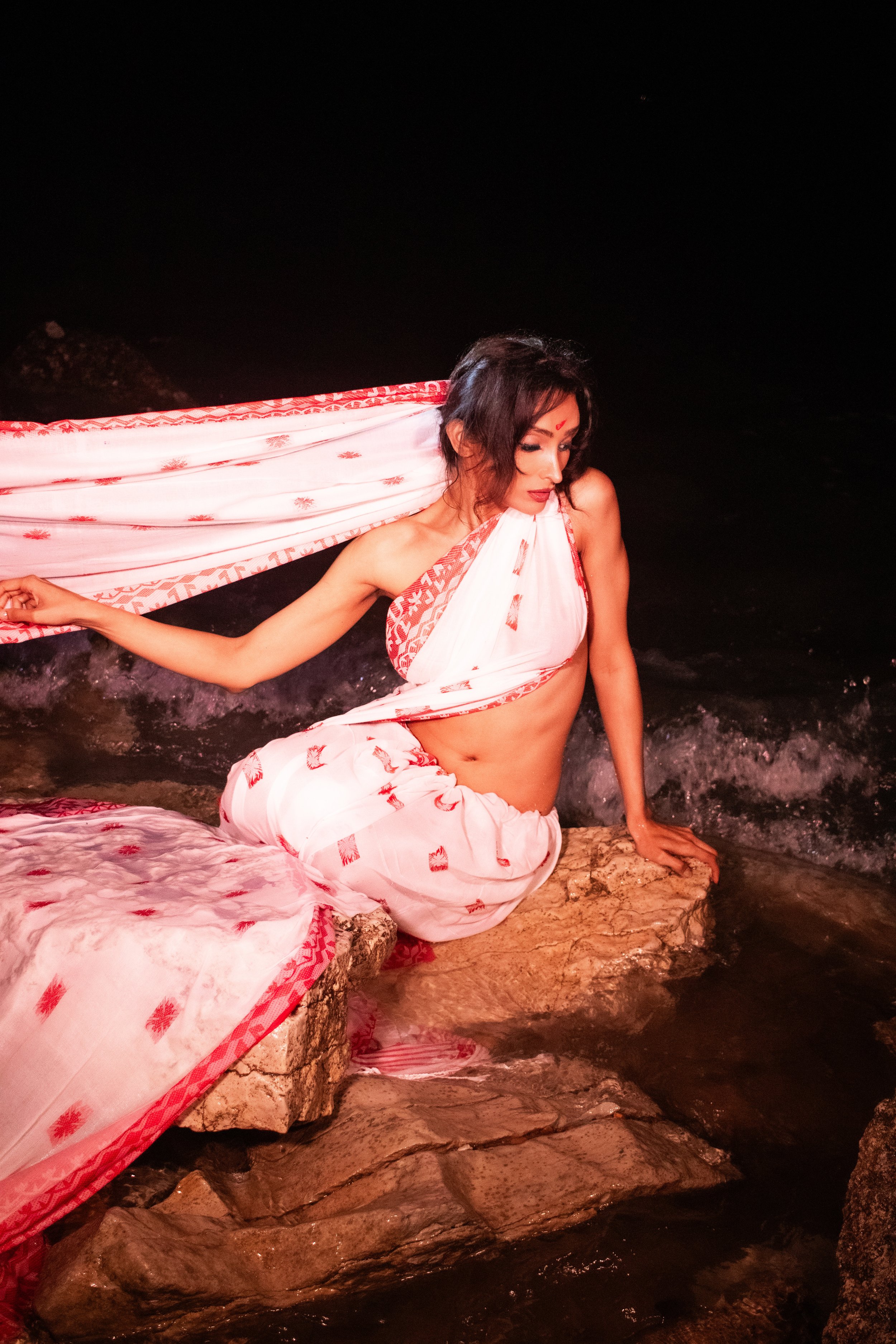
Working on the show unlocked an entire part of my psyche that I’d forgotten. I’d been going through a tough period and had been struggling with my health. The Music Box helped me then too and saved my life just with the weekly ritual of getting dressed, putting on a sari and going to the movies every week.
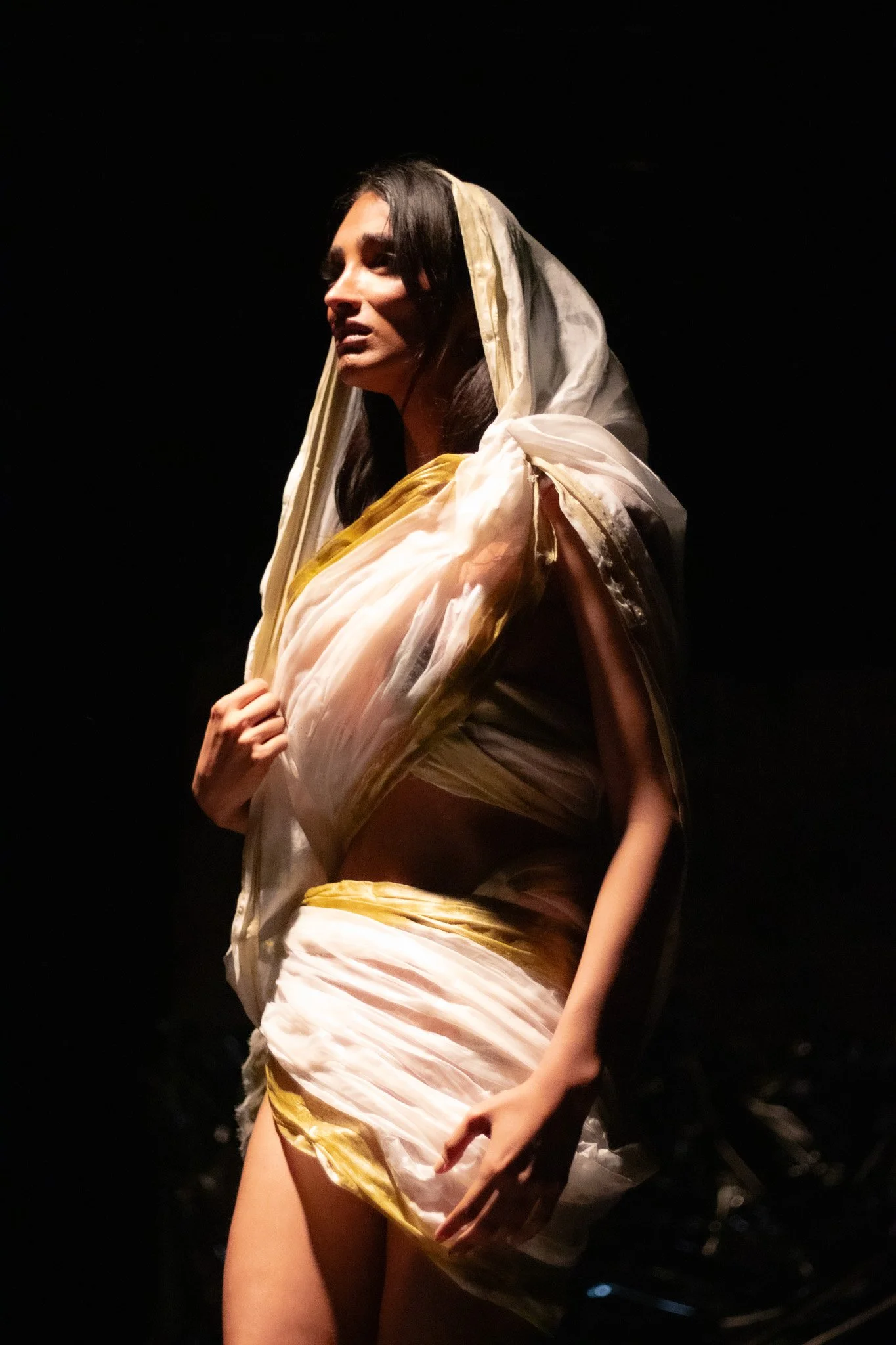
I started working on the show and I suddenly remembered how much I loved live performances as a kid. I used to be in theatre in school, and I’d emcee these shows and make my classmates perform plays with me. I used to write the entire script. I used to love that stuff. But I’d forgotten all about that because I had become a shadow of myself ; forgotten that part of myself, that confidence, and just the ability to sparkle. I found that “sparkly” part of myself in writing the show and I put all of my memories, all of my influences, all of my inspiration into the show. Every song, every visual, every reference. We had an AV installation on stage in the background, and I knew exactly every second of what video or song we should play. It was all so clear to me, and a way for me to celebrate a lifetime of worship and joy.
The first show was so cathartic, and it also was so fun. It was important knowing that I could do this. Transitioning is really hard and I’d lost so much confidence because life had been really hard. Gaining that confidence back through writing a show, even if it wasn’t something on Broadway, was a big step. Knowing I could do this — I could write an entire show from scratch, I could co-direct, I could work on the costume and then I could perform in it — brought me back to life in a way.
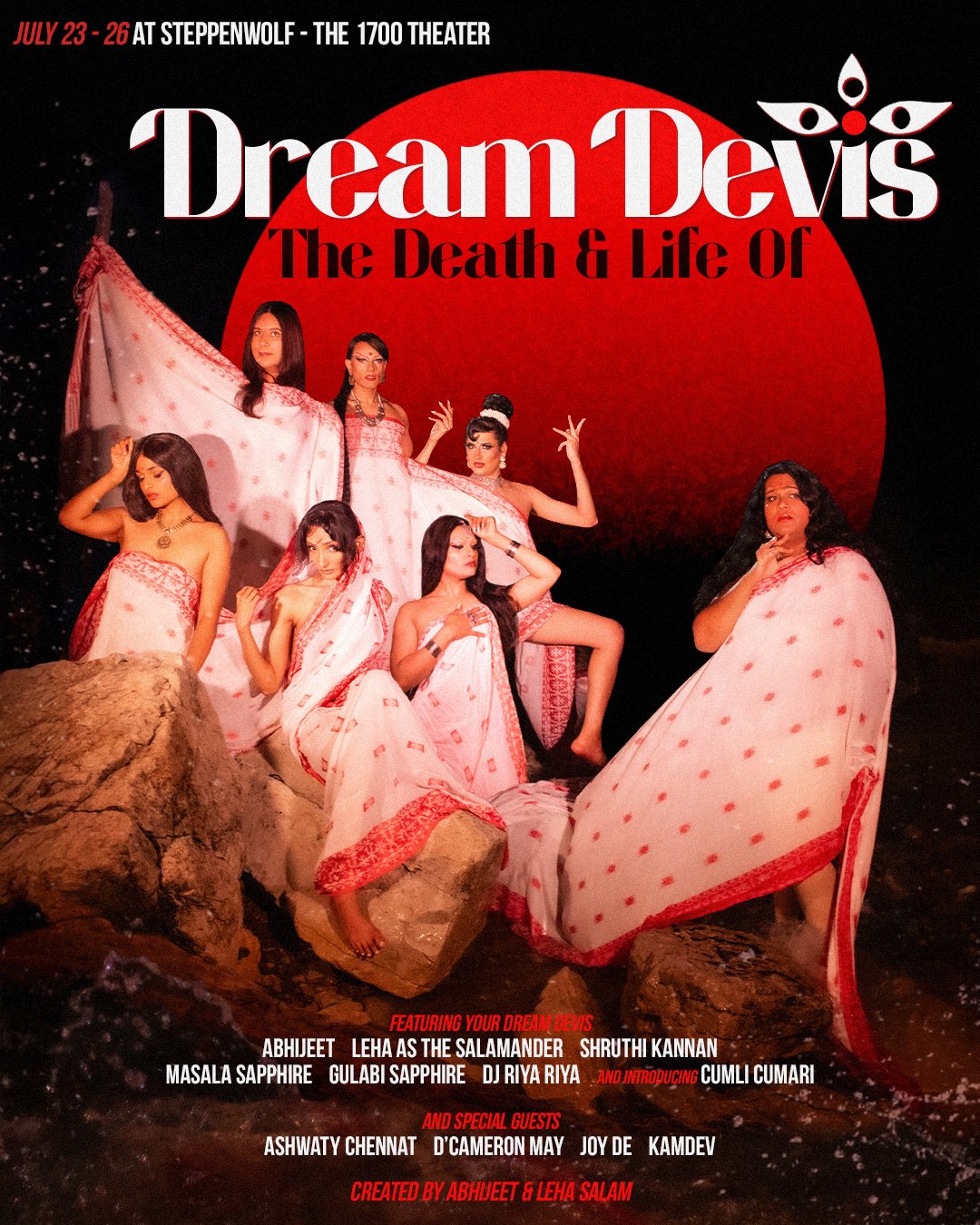
This year’s show The Death and Life of is also about coming back to life, and again about childhood memories. It’s based on a short story I’ve always loved by Tagore that I read when I was a child that I’d been obsessed with. To the point that, I thought that if I ever got a tattoo, the last line of the story, which is “by dying Kadambini had proved that she was not dead” is the tattoo I would get.
So, when Abhijeet said we’re doing another show this year and asked what we are going to do, I knew we should do this. We should do another show about feminine archetypes and women on the margins but we’re going to do this with this lens and scaffolding of Tagore’s story. Both shows then, have had me dredging up childhood memories and bringing up all this stuff that I’d forgotten. Art working as this stereotypical but truly cathartic healing experience is what is happening with the show.
It’s beautiful to hear how art has been a constant way to rearticulate your identity, find the words to say who you are, or rediscover parts of yourself that you forgot about. I am also fascinated by the title of your theatre ensemble, Dream Devis and to use the term devi to explore mythology and pop culture. What drew you guys to that name to settle on for the collective? What does it mean to imagine devis through contemporary queer South Asian performance?
The experience of trans women and, on top of that, brown trans women is this experience of constant degradation plus fetishization. These bodies are desired but at the same time, harmed constantly. They’re invisibilized and hypervisibilized. What we wanted to do was to reject all of that and say: we’re fabulous, we're gorgeous, we’re beautiful and autonomous and deserving of a gaze that is loving and worshipful — not in that kind that puts us on a pedestal, but in a way that loves us and sees us. See us not just as one thing or in this kind of purely objectifying sexual way, but as glamorous, lovely and beautiful and all of these things together. See us in the context of this larger pantheon of South Asian femme cultural representation. That was our idea. It also sounds cool.
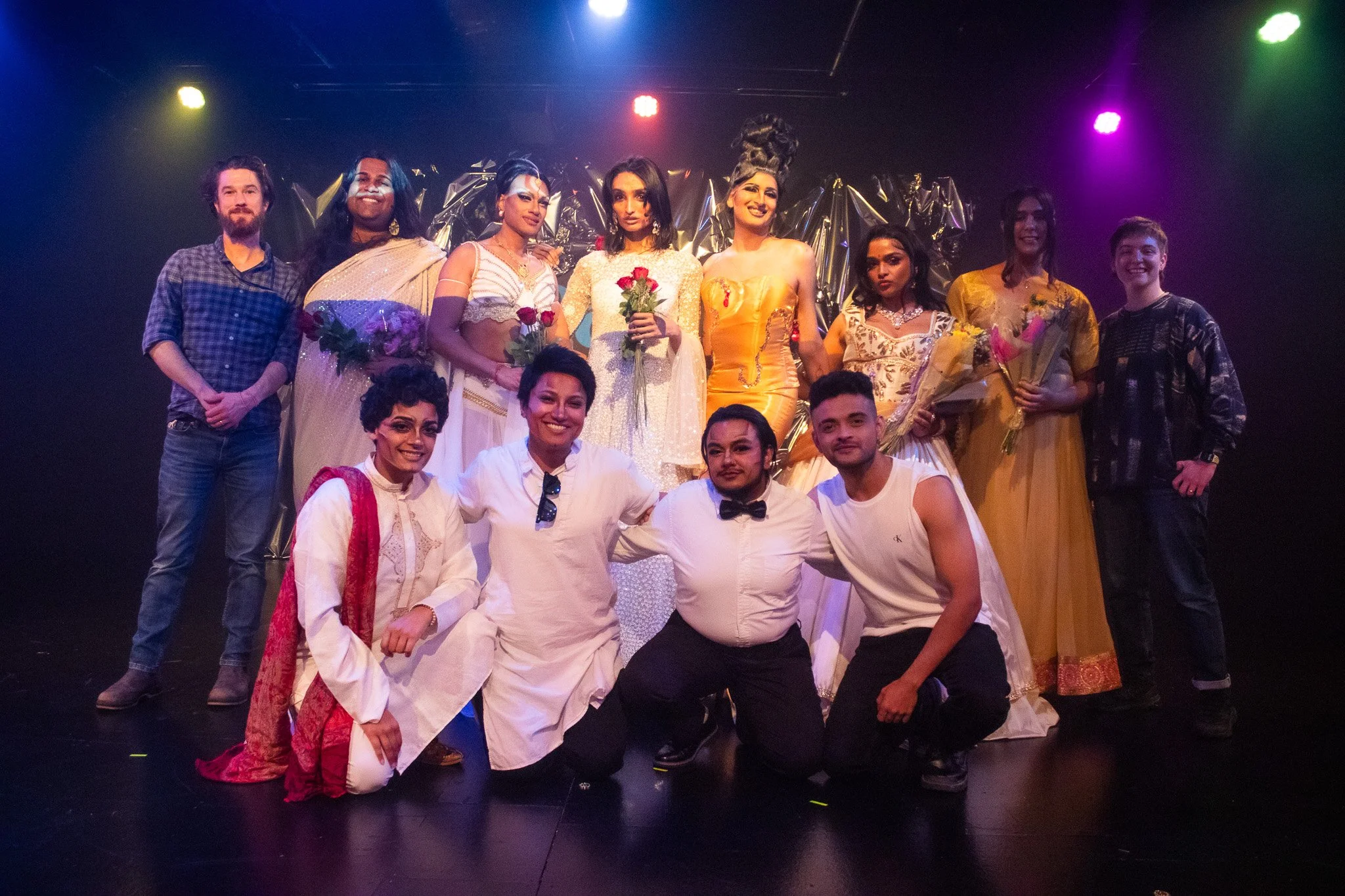
Theatre is inherently communal with the performers and the audience sharing this beautiful, shared world for the duration of the play. Is there any particular message, emotion or feeling that you want the audience to walk away with after they come see The Death And Life Of?
Exhilaration. For me, everything that I do there’s always a little bit of a connection to my mom who died when I was in my teens. I had a complicated relationship with her; once she passed was when I felt like I could leave Bangladesh. If she hadn’t, I don’t know if I would have because I loved her very much and I wanted to be there for her. I don’t know if I’d have come to America, and I don’t know what my life would have been like.
But she was also the person with whom I’d watch a lot of these movies. What she was going through as this woman in this very conservative South Asian milieu — watching her have the happiness and the joy being choked out of her — roused my feminism and my sense of justice surrounding these things. So much of me comes from my mother. Every time I do any of this stuff, both last year’s show and this year’s show, for me there is this connection to my mom.
I hope people feel exhilarated and I hope people look at their histories: look at the histories of the women, the people they come from and see them as complex, see them with some level of empathy and have curiosity. I sometimes talk to people in my life and they’ve never asked their moms any questions about their past, never asked them stories about how they grew up or their love lives when they were young. But I hope they do. Go ask your moms and aunts and your teachers and all these people in your life questions. Ask them what their life was like, who they were, and who they want to become. That would be really great if that happened.
Thinking about the overall arc of your career and through all of these different chapters of your life — as a student, writer, organizer, performer, and community builder — what threads or themes do you think feel the most continuous as you’ve navigated each chapter?
I would say, “doing it for the plot.” Really just saying, “let’s see what happens. It’s going to be interesting. Let’s go there. Let’s do the thing. Let’s say yes.”
I’m not the most ambitious person. I’m pretty shy. I have trouble asking for things and have trouble claiming my stake in things. But the way I try to compensate for that is that every time anyone presents me with an opportunity, I say yes. Saying yes to everything and just taking every opportunity no matter how scary it is, no matter how ill-prepared I am, is the thread in my life. Just going ahead and wandering.
In the show we have this enchanted forest that our heroine gets lost in, it’s the Dream Devis forest, and I think that’s my life. I’m ready to go into the forest.
How do you think being in Chicago has shaped your artistic voice?
Chicago is such a welcoming place. It’s a big city and it’s a diverse city. I know it’s structurally segregated. But, at the same time, I live in Rogers Park and it’s an incredibly diverse neighborhood. Chicago is a place where you can have the big city life, while not making the most money in the world. You can be an artist and you can live comfortably. That is not possible in LA or New York unless you’re very, very successful or a nepobaby. But that’s not Chicago. You can have community here. You don’t have to have that isolated artist life. You can work within community.
You might not have the “biggest” career here — it isn’t necessarily the place to “blow up” nationally or internationally — but you can work at a pace that feels right for you. As a person with chronic illness, being able to do things at my own pace, and live comfortably, while I’m making all of those things is incredibly valuable. Chicago has been very gracious to someone who’s been working class at several points in her life. I think I would not have been able to do most of what I do if I didn’t live in Chicago. I love New York. I love LA. I love so many places in this country. But Chicago has made my life possible.
How has Chicago informed your sense of South Asianness or how you think of yourself as a South Asian artist and creative?
It’s largely been through activism here. From the queer poets who were part of the original iterations of Trikone to nationally recognized drag artists like LaWhore Vagistan, who started out in this city, Chicago has allowed for people to flourish. I’ve seen these people, I’ve heard their stories, and I’ve been in their proximity. So many people start out here, because Chicago is a great incubator for artists. You have that liberty and freedom to make art without feeling like you’re stuck. That proximity has given me inspiration. I’ve learned from these people and these artists who have lived here or passed through and they’ve all influenced me.
I also would not have had so many opportunities if I weren’t part of such a vibrant community. For instance, my friend Abhijeet, a prominent drag artist, queer performer and producer in Chicago, brought Dream Devis to me. I performed with her all the time and she’s the one who’s making these things happen. That’s is the example of how Chicago has influenced the way I do things. People show up for my work because I have spent the last 10-12 years building deep connections within this community. Ultimately, those connections and community is what Chicago means: it’s family.
Do you have any advice for South Asian queer artists? Or any general message you’d like to share?
Firstly, just say yes. Right now is such a golden time; there’s so many people making things across the diaspora, back home and here. Watch lots of things, read lots of things, listen to lots of things, and not just contemporary things. Go back, listen to Begum Akhtar, or watch Gurudutt’s films. You don’t have to understand the language perfectly. If you’re watching a black and white film or a silent film, it doesn’t have to make perfect sense. It doesn’t have to resonate perfectly. Just do it. Immerse yourself in non-algorithmic art.
The second big thing is to show up for your friends’ things— go to their openings, go to their drag shows, go to everything. Show up for their work, and they’ll show up for yours. You have to keep watching, reading, and listening. If you don’t read, you can’t write; if you don’t watch movies or look at photographs, you can’t create visual art; if you don’t listen to music, you can’t do music. The idea that you can create art in a vacuum is impossible, and I’m not saying this because “I’m the artist,” because I don’t really think of myself that way, but you need art. You need that fuel. It’s going to make you a happier person, a more empathetic person, a person with a more vivid inner life.
More broadly too, when I think of this show or anything that I’ve done, so much of it comes from stuff I’ve read or retained from when I was a kid. I am a child of the internet, but I had a childhood that wasn’t internet-saturated. One of the benefits of that is that I carry so much of who I am from the specific influences of that time. For example, The Death and Life Of is based on a story I read when I was 10 years old or nine years old.
So hold those old selves close and treasure them. The imperfect old selves, they have a lot to tell you, they have a lot to teach you. They probably made a lot of mistakes and you’re probably embarrassed about how they looked or acted and so on. But don’t be. Those were people who were going through their own things, who were suffering, and who carried you to the person you are today. They read cool things and watched cool things. If you give them a shot and stay friends with them to a certain degree, they are going to give you the material to make with now, to heal through now, and to make friends with now. That is really what I would want to say.